


CPAC Election Updates: Hungary

Updated: Apr 13

CPAC is closely watching this very important election in Hungary today. We stand firmly with Prime Minister Viktor Orbán and the Hungarian people as they vote.
We have proudly held CPAC Hungary five times, and each gathering has been wildly successful, bringing together conservatives from across Europe and the United States to champion sovereignty, family, and national identity.
President Trump, Vice President Vance, Secretary of State Rubio, and CPAC Chairman Matt Schlapp have all endorsed Prime Minister Orbán.
He is a true example of a leader with strong conservative values who has courageously stood up to elitists and globalists from the EU and beyond to protect what is right for his country.
We are with you, Hungary.
Election Updates

44.5% for FIDESZ
42% for TISZA
7% for Mi Hazánk
The rest below the threshold.
How this will translate into seats, we most likely won’t find out quickly, and certainly not today. Of course, this could still change since it’s only a projection based on a model, but this is what Hungarian media are currently reporting.

How results are released (“batches”)
Hungary reports results progressively as precincts finish counting. When you see:
• “10% counted”
• “45% counted”
• “80% counted”
this does not represent a random national sample. It reflects which parts of the country have reported so far.
The typical reporting order
1. Small rural precincts (fastest)
2. Medium towns
3. Large cities, especially Budapest (slowest)
Because of this, each batch has a predictable political bias.
⸻
What each batch actually means
Early batches (roughly 5%–40%)
• Dominated by rural and smaller municipalities
• Historically more favorable to Fidesz
Interpretation:
• Orbán will often appear to have a large early lead
• This lead is usually inflated, not final
• Media headlines at this stage often overstate his position
What to watch:
• Are opposition candidates competitive in districts already reporting?
• Is Orbán’s margin unusually large even for rural areas?
⸻
Middle batches (40%–80%)
• More representative mix of the country
• Includes mid-sized cities and some urban districts
Interpretation:
• This is where the true trajectory becomes visible
• If Orbán’s lead holds steady, that is a strong sign of control
• If his lead shrinks meaningfully, the race is tightening
What to watch:
• District-by-district changes, not just national percentages
• Whether opposition begins flipping or closing gaps in key districts
⸻
Late batches (80%–100%)
• Heavy inclusion of Budapest and large urban areas
• Often includes slower-counting precincts
Interpretation:
• This is where opposition parties tend to perform better
• Final margins settle here
What to watch:
• Does the late urban vote narrow the gap significantly, or only slightly?
• If Orbán still leads comfortably after urban votes are in, the outcome is effectively decided
⸻
Why batches can be misleading
A headline like:
• “Fidesz leads by 15 points with 30% counted”
usually means:
• Rural areas have reported
• Urban areas have not
So the correct interpretation is:
• “Fidesz is performing as expected in early-reporting areas”
—not necessarily that the election is decided.
⸻
The key indicator inside each batch
The most important signal is not the national percentage, but:
District performance
• Are Fidesz candidates winning most districts?
• Are margins close or comfortable?
Even if national vote share tightens later, winning districts early and consistently strongly favors Orbán.
⸻
What the batches mean for Orbán specifically
Scenario 1: Strong early lead, stable through middle batches
• Orbán maintains large margins even as more votes come in
• Opposition fails to close the gap
Meaning:
• Clear path to victory
• Likely strong parliamentary majority
⸻
Scenario 2: Strong early lead, but shrinking in middle batches
• Early rural advantage fades as urban votes come in
Meaning:
• Race is competitive
• Still favorable for Orbán if he holds most districts
• But signals reduced dominance
⸻
Scenario 3: Lead collapses late
• Large early lead narrows sharply once Budapest reports
Meaning:
• Opposition significantly overperforming expectations
• Potential upset or much tighter parliament
⸻
Scenario 4: Weak early performance
• Orbán’s margins are small even in early rural batches
Meaning:
• Warning sign
• Indicates broader national weakness
• Increases probability of a close or unfavorable outcome
⸻
Quick way to interpret results in real time
When a new batch comes out, ask:
1. Where are these votes coming from?
Early = rural; late = urban
2. Is Orbán’s margin changing?
Stable = strong position
Shrinking = pressure
3. Who is winning districts?
This matters more than raw percentages
⸻
Bottom line
• Early batches tend to overstate Orbán’s strength
• Middle batches reveal whether that strength is real or inflated
• Late batches show whether the opposition can meaningfully close the gap
• If Orbán maintains a solid lead through the middle phase, the outcome is usually settled
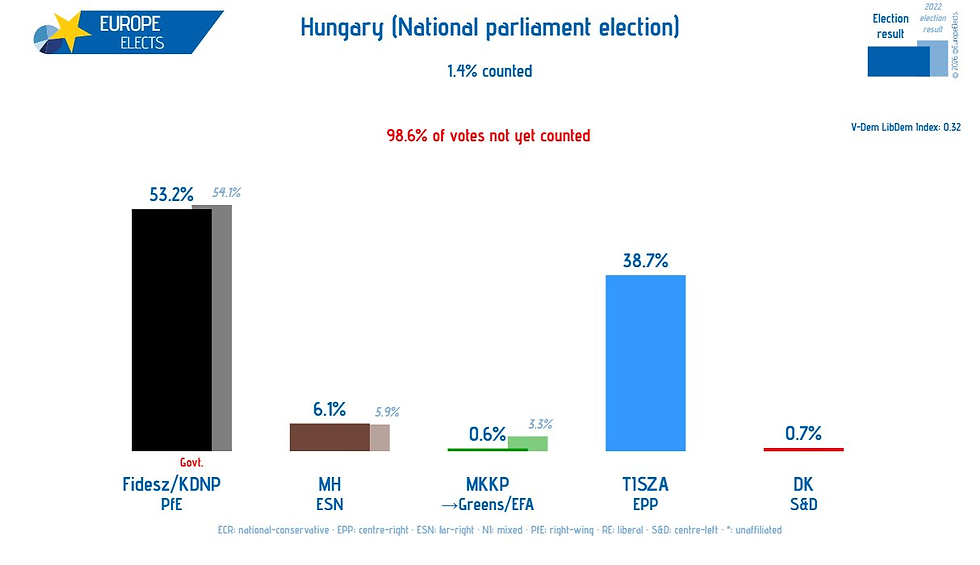
Hungary, 1.4% counted:
98.6% of votes not yet counted
National parliament election
Fidesz/KDNP-PfE: 53.2% (-0.9)
TISZA-EPP: 38.7% (+38.7)
MH-ESN: 6.1% (+0.2)
DK-S&D: 0.7% (+0.7)
MKKP→G/EFA: 0.6% (-2.7)
+/- vs. 2022 election

Hungary, 6.5% counted:
National parliament election
TISZA-EPP: 47.8% (+9.1)
Fidesz/KDNP-PfE: 43.7% (-9.5)
MH-ESN: 6.2% (+0.1)
DK-S&D: 1.1% (+0.4)
MKKP→G/EFA: 0.7% (+0.1)
+/- vs. 1.4% counted

Hungary, List vote, 10.4% counted:
National parliament election
TISZA-EPP: 49.4% (+1.6)
Fidesz/KDNP-PfE: 42.0% (-1.7)
MH-ESN: 6.1% (-0.1)
DK-S&D: 1.2% (+0.1)
MKKP→G/EFA: 0.7%
+/- vs. 6.5% counted


.png)


_gif.gif)